
Biomassa adsorvente de metais pesados: uma revisão para seu desenvolvimento em larga escala na Colômbia.
Barra lateral de artigos




Conteúdo do artigo principal
Resumo
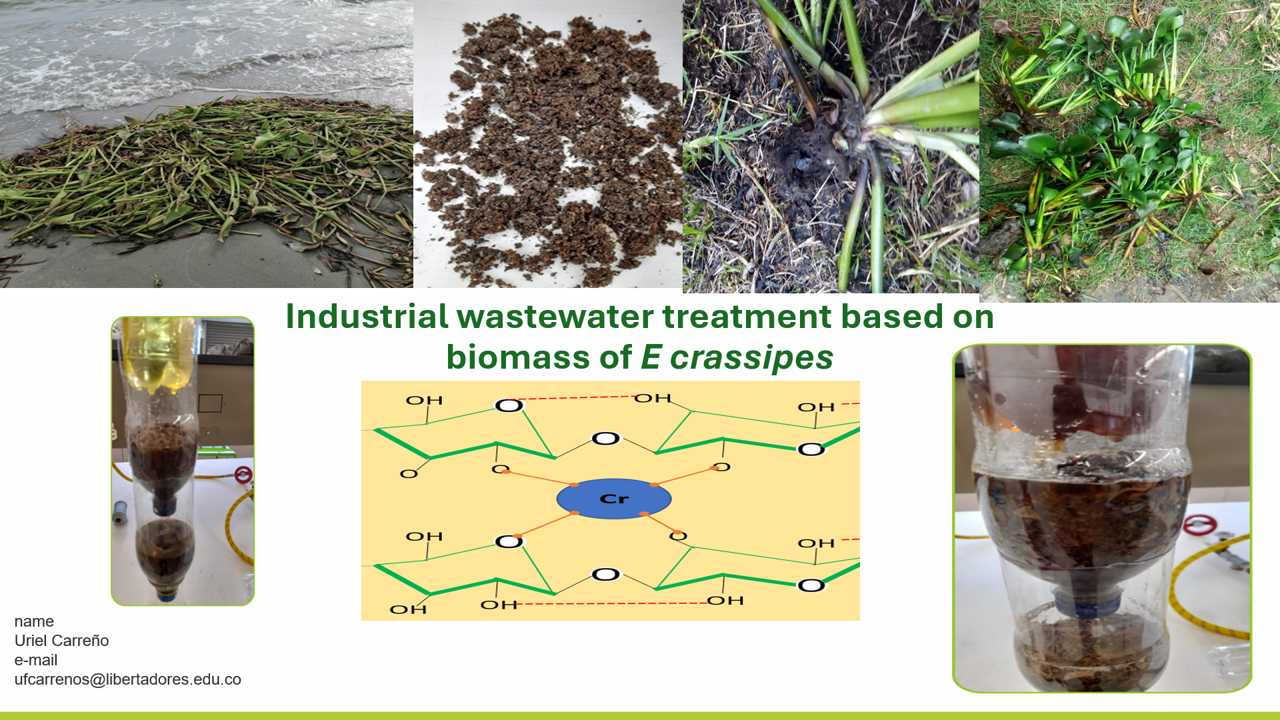
Adsorventes à base de biomassa tornaram-se objeto de pesquisa científica para o tratamento de águas residuais químicas em todo o mundo, devido à sua capacidade de remover contaminantes como metais pesados e corantes. Sistemas de tratamento em escala piloto que utilizam esses materiais de biomassa demonstraram viabilidade, impulsionada pelos baixos custos, pela facilidade de instalação e — acima de tudo — pela elevada capacidade de adsorção de metais pesados. Fontes de biomassa, como a *E. crassipes*, têm sido secas e moídas para preparar o material celulósico para uso em sistemas de tratamento com colunas de leito fixo. Este artigo de revisão visa examinar a fundo diversos tipos de biomassa e determinar os custos unitários de desenvolvimento do material em relação às capacidades de adsorção. O estudo conclui que diferentes materiais de biomassa são adequados a diferentes efluentes, com base em suas cargas de poluentes, estabelecendo-os como um excelente recurso para o tratamento de águas residuais industriais, particularmente para a remoção de metais pesados.
Detalhes do artigo
Seção
Se solicita a los autores que diligencien el documento de cesión de derechos de autor sobre el artículo, para que sea posible su edición, publicación y distribución en cualquier medio y modalidad: medios electrónicos, CD ROM, impresos o cualquier otra forma, con fines exclusivamente científicos, educativos y culturales
- La obra pertenece a UNIMINUTO.
- Dada la naturaleza de UNIMINUTO como Institución de Educación Superior, con un modelo universitario innovador para ofrecer Educación de alta calidad, de fácil acceso, integral y flexible; para formar profesionales altamente competentes, éticamente responsables y líderes de procesos de transformación social, EL CEDENTE ha decidido ceder los derechos patrimoniales de su OBRA, que adelante se detalla para que sea explotado por ésta
- El querer de EL CEDENTE es ceder a título gratuito los derechos patrimoniales de la OBRA a UNIMINUTO con fines académicos.
Como Citar
Referências
1. Carreño Sayago, U. F. (2016). Diseño y evaluación de un biosistema de tratamiento a escala piloto de aguas de curtiembres a través de la Eichhornia crassipes. Revista Colombiana de Biotecnología, 18(2), 74-81.
2. Navas-Ulloa, A. E., Vallejo, F., Yánez, D., Brito, J. N., Ayabaca-Sarria, C., Tirado-Lozada, A., & Venegas-Vásconez, D. (2026). Scientific mapping of mining expansion in Ecuador: A PRISMA systematic review of territorial change and biosanitary implications in Latin America. Environments, 13(5), 235.
3. Sayago, U. F. C., Castro, Y. P., Rivera, L. R. C., & Mariaca, A. G. (2020). Estimation of equilibrium times and maximum capacity of adsorption of heavy metals by E. crassipes. Environmental monitoring and assessment, 192, 1-16.
4. Carreño-Sayago, U. F. (2021). Development of microspheres using water hyacinth (Eichhornia crassipes) for treatment of contaminated water with Cr (VI). Environment, Development and Sustainability, 23(3), 4735-4746.
5. Da Silva, J., Franco, D., García, A. L., Pacheco-Pantoja, E. L., Simoniello, M. F., Tirado, N., ... & Rojas, E. (2026). Alkaline comet assay in human biomonitoring studies by the Latin America/LA-COMET group. Mutation Research-Genetic Toxicology and Environmental Mutagenesis, 503940.
6. Calizaya-Anco, J. A., Cutipa-Díaz, Y. M., Rubira-Otarola, D. G., Denegri-Limache, K. A., & Limache-Sandoval, E. M. (2026). Evaluation of the Trophic State of Lagoons and Reservoirs in High Andean Southern Peru. Limnological Review, 26(2), 14.
7. Gómez-Oquendo, G., Fernandez-Curi, M., Carrión-Carrera, G., Garcia, S., Velarde-Guillén, J., & Gómez-Bravo, C. (2026). Heavy metals and selenium in pastures of a high Andean mining area and its relationship with their content in water and soil. Journal of Ecological Engineering, 27(1), 280-291.
8. Alves, J. A., Cunha, P. M. M., de Souza Meireles, G., Correia, F. V., de Sá Salomão, A. L., Hauser-Davis, R. A., & Saggioro, E. M. (2026). Metal-Driven Biochemical and Physiological Stress in Fish Inhabiting an Urban Coastal Lagoon: Evidence from an Integrated Multibiomarker Approach. Biological Trace Element Research, 1-22.
9. Carreno Sayago, U. F. (2021). Design, scaling, and development of biofilters with e crassipes for treatment of water contaminated with Cr (VI). Water, 13(9), 1317.
10. Calizaya-Anco, J. A., Cutipa-Díaz, Y. M., Rubira-Otarola, D. G., Denegri-Limache, K. A., & Limache-Sandoval, E. M. (2026). Evaluation of the Trophic State of Lagoons and Reservoirs in High Andean Southern Peru. Limnological Review, 26(2), 14.
11. Sayago, U. F. C. (2021). Design and development of a biotreatment of E. crassipes for the decontamination of water with Chromium (VI). Scientific Reports, 11(1), 9326.
12. Abiodun, O. A. O., Oluwaseun, O., Oladayo, O. K., Abayomi, O., George, A. A., Opatola, E., ... & Omotayo, I. A. (2023). Remediation of heavy metals using biomass-based adsorbents: adsorption kinetics and isotherm models. Clean Technologies, 5(3), 934-960.
13. Carreño-Sayago, U. F. (2022). Design of biocolumns with dry and crushed biomass of E. crassipes for the treatment of water contaminated with Cr (VI).
14. Paranjape, P., & Sadgir, P. (2023). Heavy metal removal using plant origin biomass and agricultural waste-derived biomass from aqueous media: a review. Water Conservation Science and Engineering, 8(1), 9.
15. Sayago, U. F. C., and Ballesteros Ballesteros, V. (2023). Development of a treatment for water contaminated with Cr (VI) using cellulose xanthogenate from E. crassipes on a pilot scale. Scientific Reports, 13(1), 1970.
16. Fan, Y., Zhang, S., Wang, X., Yang, L., Li, H., & Gao, K. (2025). The potential of Pontederia crassipes to remediate heavy metals in water. Plants, 14(23), 3604.
17. Carreño Sayago, U. F., Piñeros Castro, Y., & Conde Rivera, L. R. Design of a fixed-bed column with vegetal biomass and its recycling for Cr (VI) treatment. 2022. Recycling, 7(5), 71.
18. Sayago, U. F. C., and Castro, Y. P. (2022). Development of a composite material between bacterial cellulose and E crassipes, for the treatment of water contaminated by chromium (VI). International Journal of Environmental Science and Technology, 19(7), 6285-6298.
19. Sayago, U. F. C., and Ballesteros Ballesteros, V. (2023). Recent advances in the treatment of industrial wastewater from different celluloses in continuous systems. Polymers, 15(19), 3996.
20. Sayago, U. F. C. (2023). Design and development of a pilot-scale industrial wastewater treatment system with plant biomass and EDTA. Water, 15(19), 3484.
21. Sayago, U. F. C., and Ballesteros Ballesteros, V. (2023). Development of a treatment for water contaminated with Cr (VI) using cellulose xanthogenate from E. crassipes on a pilot scale. Scientific Reports, 13(1), 1970.
22. Sayago, U. F. C., & Ballesteros Ballesteros, V. (2024). Development of a wastewater treatment system contaminated with Cr (VI) through vegetable biomass modified with TIO2. International Journal of Environmental Science and Technology, 1-14.
23. Fan, Y., Zhang, S., Wang, X., Yang, L., Li, H., & Gao, K. (2025). The potential of Pontederia crassipes to remediate heavy metals in water. Plants, 14(23), 3604.
24. Garg, A., Yadav, B. K., Das, D. B., & Wood, P. J. (2022). Biomonitoring and phytoremediation of Cr (VI) contaminated water: Study on bioaccumulation and morphological responses in Eichhornia crassipes. Journal of Environmental Engineering, 148(12), 04022075.
25. Sayago, U. F. C., Ballesteros, V. B., & Lozano, A. M. (2025). Development of a Treatment System of Water with Cr (VI) Through Models Using E. crassipes Biomass with Iron Chloride. Toxics, 13(3), 230.
26. Sayago, U. F. C., & Ballesteros Ballesteros, V. (2025). Development of a wastewater treatment system contaminated with Cr (VI) through vegetable biomass modified with TIO2. International Journal of Environmental Science and Technology, 22(8), 6521-6534.
27. Sayago, U. F. C., & Ballesteros, V. A. B. (2024). The Design of a Process for Adsorbing and Eluting Chromium (VI) Using Fixed-Bed Columns of E. crassipes with Sodium Tripolyphosphate (TPP). Water, 16(7), 952.
28. Sayago, U. F. C., Ballesteros, V. B., & Aguilar, A. M. L. (2024). Bacterial Cellulose-Derived Sorbents for Cr (VI) Remediation: Adsorption, Elution, and Reuse. Polymers, 16(18), 2605.
29. Sayago, U. F. C., Ballesteros, V. B., & Aguilar, A. M. L. (2024). Designing, Modeling and Developing Scale Models for the Treatment of Water Contaminated with Cr (VI) through Bacterial Cellulose Biomass. Water, 16(17), 2524.
30. Sayago, U. F. C., Ballesteros, V. B., & Lozano, A. M. (2025). Design of Biomass Adsorbents Based on Bacterial Cellulose and E. crassipes for the Removal of Cr (VI). Polymers, 17(12), 1712.
31. Sayago. U.F.C (2025). Determining the Impact of Temperature on Cr (IV) Adsorption Using Bacterial Cellulose Biomass as an Adsorbent. Processes, 13(11), 3493.
32. Sayago. U.F.C (2025). Treatment of Water Contaminated with Cr (VI) Using Bacterial Cellulose and FeCl3 in a Continuous System. Applied Sciences, 15(23), 12808.
33. Sayago, U. F. C., Ballesteros, V. B., Aguilar, A. M. L., & Nisperuza, J. L. (2026). Design and develop a prototype fixed column using bacterial cellulose and ferric chloride for Cr (VI) removal. Frontiers in Systems Biology, 6, 1844304.
34. Carreño Sayago, U.F.; Ballesteros, V.B.; Lozano Aguilar, A.M. Development of a Cr(VI) Treatment System Using Bacterial Cellulose Biomass and Eichhornia crassipes. Processes 2026, 14, 2325. https://doi.org/10.3390/pr14142325
35. Tejada-Tovar, C.N.; Villabona-Ortíz, A.; Alvarez-Bajaire, G.; Granados-Conde, C. Influencia de la altura del lecho sobre el comportamiento dinámico de columna de lecho fijo en la biosorción de mercurio. TecnoLógicas 2019, 20, 71–81.
36. Saralegui, A.B.; Willson, V.; Caracciolo, N.; Piol, M.N.; Boeykens, S.P. Macrophyte biomass productivity for heavy metal adsorption. J. Environ. Manag. 2021, 289, 112398.
37. Gupta, S.; Jain, A.K. Biosorption of Ni (II) from aqueous solutions and real industrial wastewater using modified A. barbadensis Miller leaves residue powder in a lab scale continuous fixed bed column. Clean. Eng. Technol. 2021, 5, 100349.
38. De Sá Costa, H.P.; da Silva, M.G.C.; Vieira, M.G.A. Fixed bed biosorption and ionic exchange of aluminum by brown algae residual biomass. J. Water Process Eng. 2021, 42, 102
39. Han, X.; Zhang, Y.; Zheng, C.; Yu, X.; Li, S.; Wei, W. Enhanced Cr (VI) removal from water using a green synthesized nanocrystalline chlorapatite: Physicochemical interpretations and fixed-bed column mathematical model study. Chemosphere 2021, 264, 128421. [Google Scholar]
40. Ghasemabadi, S.M.; Baghdadi, M.; Safari, E.; Ghazban, F. Investigation of continuous adsorption of Pb (II), As (III), Cd (II), and Cr (VI) using a mixture of magnetic graphite oxide and sand as a medium in a fixed-bed column. J. Environ. Chem. Eng. 2018, 6, 4840–4849.
41. Zhang, P.; Zou, K.; Yuan, L.; Liu, J.; Liu, B.; Qing, T.P.; Feng, B. A biomass resource strategy for alginate-polyvinyl alcohol double network hydrogels and their adsorption to heavy metals. Sep. Purif. Technol. 2022, 301, 122050.
42. Zhang, P.; Yuan, L.; Zeng, J.; Zou, K.; Liu, B.; Qing, T.; Feng, B. Alginate production of Pseudomonas strains and its application in preparation of alginate-biomass hydrogel for heavy metal adsorption. Int. J. Biol. Macromol. 2022, 222, 1511–1521.
43. Alabi, A.H.; Adekunle, V.A.; Azeez, A.A.; Akinwale, B.W.; Olanrewaju, C.A.; Oladoye, P.O.; Obayomi, K.S. Sequestration of divalent heavy metal ions from aqueous environment by adsorption using biomass-bentonite composites as potential adsorbent: Equilibrium and kinetic studies. Nano-Struct. Nano-Objects 2024, 38, 101183.
44. Znad, H.; Awual, M.R.; Martini, S. The utilization of algae and seaweed biomass for bioremediation of heavy metal-contaminated wastewater. Molecules 2022, 27, 1275.
45. Ali, Z.; Sajid, M.; Raza, N.; Sohail, Y.; Hayat, M.; Manzoor, S.; Shakeel, N.; Gill, K.A.; Ifseisi, A.A.; Ansari, M.Z. Study of modified biomass of Gossypium hirsutum as heavy metal biosorbent. Arab. J. Chem. 2023, 16, 105332.
46. Naseem, K.; Imran, Q.; Ur Rehman, M.Z.; Tahir, M.H.; Najeeb, J. Adsorptive removal of heavy metals and dyes from wastewater using Azadirachta indica biomass. Int. J. Environ. Sci. Technol. 2023, 20, 5799–5822.
47. Oukhemamou, S.; Belaid, T.; Bey, S.; Arauzo, P.J.; Checa-Gómez, M.; Benamor, M. Biosorption of hexavalent chromium by a low-cost sorbent (potato peels): Kinetics, equilibrium, and thermodynamics. Environ. Sci. Pollut. Res. 2026, 33, 506–525.
48. Fernández, L.A.G.; Frómeta, A.E.N.; Álvarez, C.C.; Ramírez, R.F.; Flores, P.E.D.; Ramos, V.C.; Polo, M.S.; Marín, F.C.; Castillo, N.A.M. Valorization of sargassum biomass as potential material for the remediation of heavy-metals-contaminated waters. Int. J. Environ. Res. Public Health 2023, 20, 2559.
49. Condurache, B.C.; Cojocaru, C.; Samoila, P.; Cosmulescu, S.F.; Predeanu, G.; Enache, A.C.; Harabagiu, V. Oxidized biomass and its usage as adsorbent for removal of heavy metal ions from aqueous solutions. Molecules 2022, 27, 6119.
50. Wiśniewska, M.; Marciniak, M.; Gęca, M.; Herda, K.; Pietrzak, R.; Nowicki, P. Activated biocarbons obtained from plant biomass as adsorbents of heavy metal ions. Materials 2022, 15, 5856.
51. Rohman, G.A.N.; Aziz, M.A.; Nawaz, A.; Elgzoly, M.A.; Hossain, M.M.; Razzak, S.A. High-performance biochar from Chlorella pyrenoidosa algal biomass for heavy metals removal in wastewater. Sep. Purif. Technol. 2024, 341, 126870.
52. Sireesha, S.; Upadhyay, U.; Sreedhar, I. Comparative studies of heavy metal removal from aqueous solution using novel biomass and biochar-based adsorbents: Characterization, process optimization, and regeneration. Biomass Convers. Biorefinery 2022, 15, 21643–21655.
53. Li, J.; Lv, F.; Yang, R.; Zhang, L.; Tao, W.; Liu, G.; Gao, H.; Guan, Y. N-doped biochar from lignocellulosic biomass for preparation of adsorbent: Characterization, kinetics and application. Polymers 2022, 14, 3889.
54. Emenike, E.C.; Okoro, H.K.; Al-Senani, G.M.; Al-Qahtani, S.D.; Iwuozor, K.O.; Egbemhenghe, A.U.; Emeghai, J.; Adeniyi, A.G. Adsorptive removal of Cr (VI) and Pb (II) using biochar from biomass and plastic waste: Characterization and performance evaluation. Biomass Bioenergy 2026, 207, 108722.
55. Li, A.; Xie, H.; Qiu, Y.; Liu, L.; Lu, T.; Wang, W.; Qiu, G. Resource utilization of rice husk biomass: Preparation of MgO flake-modified biochar for simultaneous removal of heavy metals from aqueous solution and polluted soil. Environ. Pollut. 2022, 310, 119869.
56. Licona-Aguilar, Á.I.; Torres-Huerta, A.M.; Domínguez-Crespo, M.A.; Palma-Ramírez, D.; Conde-Barajas, E.; Negrete-Rodríguez, M.X.L.; Rodríguez-Salazar, A.E.; García-Zaleta, D.S. Reutilization of waste biomass from sugarcane bagasse and orange peel to obtain carbon foams: Applications in the metal ions removal. Sci. Total Environ. 2022, 831, 154883.
57. Adegoke, K.A.; Akinnawo, S.O.; Ajala, O.A.; Adebusuyi, T.A.; Maxakato, N.W.; Bello, O.S. Progress and challenges in batch and optimization studies on the adsorptive removal of heavy metals using modified biomass-based adsorbents. Bioresour. Technol. Rep. 2022, 19, 101115.
58. Abou-Hadid, A.F.; El-Behairy, U.A.; Elmalih, M.M.; Amdeha, E.; Naggar, A.M.E.; Taha, M.H.; Hussein, A.E. Conversion of corn shell as biomass solid waste into carbon species for efficient decontamination of wastewater via heavy metals adsorption. Biomass Convers. Biorefinery 2024, 14, 16435–16449.
59. El-Gendy, M.M.A.A.; Abdel-Moniem, S.M.; Ammar, N.S.; El-Bondkly, A.M.A. Bioremoval of heavy metals from aqueous solution using dead biomass of indigenous fungi derived from fertilizer industry effluents: Isotherm models evaluation and batch optimization. Biometals 2023, 36, 1307–1329.
60. Zhao, H.; Dong, W.; Deng, Y.; Chen, L.; Zhao, C.; Zhang, C.; Zhou, J.; Qu, Y.; Li, Y.; Li, D.; et al. Biomass-based biomimetic-oriented Janus nanoarchitecture for efficient heavy-metal enrichment and interfacial solar water sanitation. Interdiscip. Mater. 2022, 1, 537–547.
61. Zhang, Y.; Li, A.; Liu, L.; Duan, X.; Ge, W.; Liu, C.; Qiu, G. Enhanced remediation of cadmium-polluted soil and water using facilely prepared MnO2-coated rice husk biomass. Chem. Eng. J. 2023, 457, 141311.